
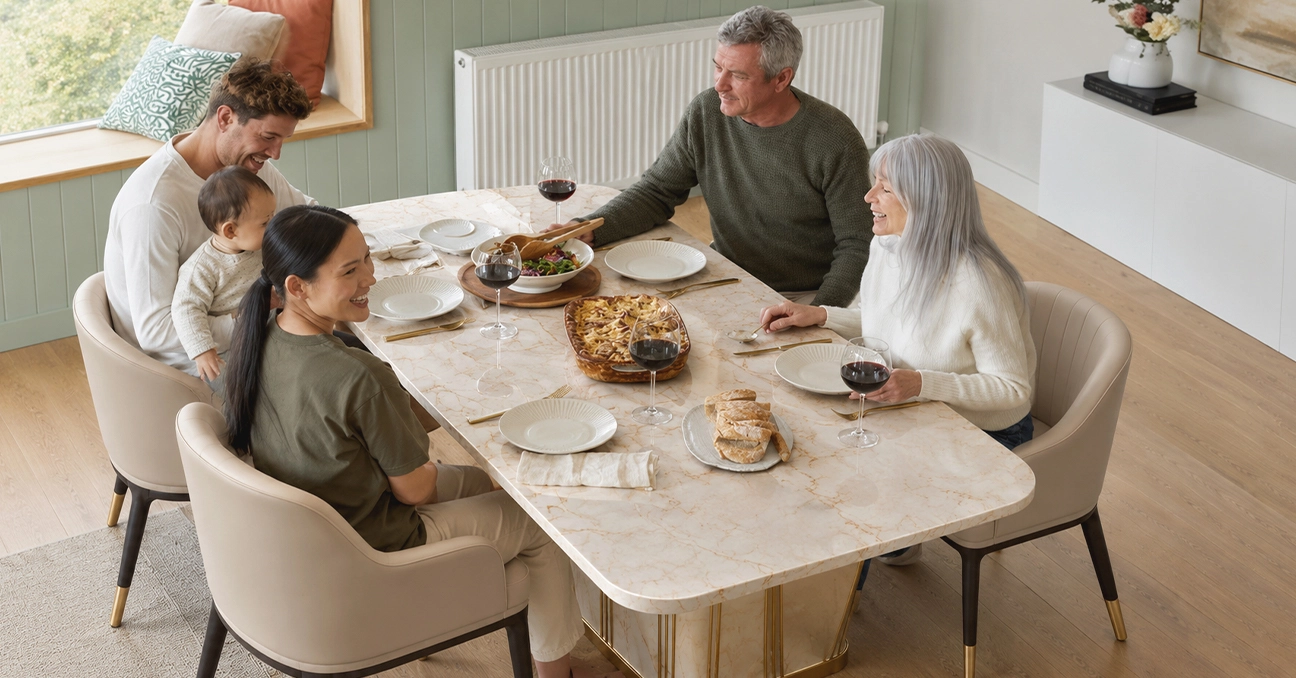
Wood has owned the dining room for long enough. It is familiar, practical, and everywhere, which is precisely why your dining space might be craving something with more visual bite. Marble enters differently. It reflects light, carries natural patterns, and gives an ordinary dining setup a stronger architectural presence. Yet choosing marble should involve more than falling for a dramatic photograph. Size, surface behavior, maintenance, weight, and styling all matter. If your current table feels more background prop than room-defining furniture, here are seven compelling reasons a marble dining table could give your dining space the shake-up it has been waiting for.
Dining tables are large pieces of furniture, so allowing one to disappear visually can feel like a missed opportunity. Marble takes up space with intention.
The veining creates movement across the table surface, giving the eye something to follow even when the table is completely bare. Depending on the stone those markings can appear cloudy, linear, fragmented, sweeping, or dramatically contrasted.
That makes a marble dining table particularly appealing when you want the dining area to have a distinct visual center. Instead of relying on several decorative objects to create interest, the surface itself contributes to the room.
This can also simplify styling. A vase, compact centerpiece, or pendant above the table may be enough because marble already supplies texture and variation as well.
Before buying, however, study photographs of the entire slab or table surface when available. Natural stone varies. A sample photograph may communicate the general color direction without representing the exact pattern you receive.
That unpredictability is part of the marble’s character. Rather than repeating an identical printed pattern, natural veining creates subtle individuality from one table surface to another.
Lighting can completely alter how dining furniture feels throughout the day. Marble interacts with changing light particularly well because its tones and veining can appear different depending on the direction and strength of illumination.
A pale white marble dining table can help bounce available light around a dining area, creating a brighter visual impression. Darker marble produces a different effect, introducing contrast and making surrounding lighter furniture stand out more clearly.
Artificial lighting matters too. Warm pendant lighting can soften cooler stone tones during dinner, while brighter daytime lighting can reveal smaller details within the veining.
This gives marble a shifting personality without requiring constant decorating changes.
When planning your dining room, look at where natural light enters and how overhead fixtures sit in relation to the table surface. Highly reflective finishes may show stronger glare beneath direct lighting, while softer finishes can produce a more muted appearance.
A table should not be chosen in isolation. Think of the surface, room lighting, wall colors, chairs, flooring, and surrounding furniture as one visual conversation.
Mention marble and some people tend to immediately imagine highly formal dining rooms. That picture is far too narrow.
Marble can move between modern, minimalist, industrial, transitional, eclectic, and classic interiors depending on its color, shape, base, and surrounding furniture.
A modern marble dining table with a streamlined base can feel crisp and architectural. Pair the same pale stone with upholstered chairs and warmer textures, and the room becomes softer. Dark stone paired with metal can create stronger contrast, while subtle veining alongside timber accents can produce an earthy balance.
The trick is resisting the urge to make every element compete.
If the marble has expressive veining, simpler chairs can allow the table to command attention. If the stone pattern is quieter, stronger chair silhouettes or textured upholstery can introduce additional personality.
This flexibility is specifically useful when your interior changes gradually. Chairs, rugs, lighting, and wall colors are easier to replace than a substantial dining table. Choosing a versatile table can therefore give future decorating decisions more breathing room.
Repetition is useful for manufactured materials because shoppers generally know what they will receive. Natural stone follows a different script.
Veining, tonal changes, mineral markings, and pattern density can vary between slabs. These differences mean a natural marble dining table can have visual details that are not precisely duplicated elsewhere.
For some buyers, that’s a major attraction.
Rather than seeing variation as flaws, think of it as part of the material itself. The surface records geological processes through patterns that developed long before the stone became furniture.
Still, shoppers need realistic expectations. Product photographs may show representative patterns rather than the exact table surface being delivered. Ask the seller how much variation should be expected and whether images of individual pieces are available.
Color can also vary slightly depending on lighting and photography. A stone that appears bright and white on screen may contain warmer, cooler, gray, beige, or cream undertones in person.
Understanding variation before ordering helps prevent surprises when the table finally enters your dining room.
Changing the material is only half the story. Changing the table shape can completely alter how people move through and gather within a dining area.
A round marble dining table creates a strong central point without introducing sharp corners. It can suit square rooms, breakfast areas, and spaces where people frequently move around the table. Round formats can also encourage conversation because diners face one another more directly.
Rectangular marble tables suit longer rooms and usually offer straightforward seating arrangements. They can visually emphasize the length of a dining area and work well when larger groups regularly gather.
Oval tables sit somewhere between the two. They provide length while softening the corners, creating a flowing silhouette that can make substantial stone feel visually lighter.
Before selecting any shape, measure beyond the table surface itself. Chairs need room to pull backward, and people need sufficient space to walk behind occupied seats.
Anyone searching for a marble dining table for 6 people should pay particular attention to leg or pedestal placement. A beautiful base becomes frustrating quickly if it restricts comfortable seating positions.
Some surfaces invite you to drop everything on them without thinking. Marble tends to encourage slightly more deliberate habits, and that is not necessarily a disadvantage.
Coasters, place-mats, trivets, and serving boards can become part of the dining setup. These accessories help reduce exposure to spills, heat, scratches, and acidic foods while also introducing another layer of styling.
Marble is porous, so spills should not be left sitting unnecessarily. Acidic substances can also affect the finish and create dull patches through etching. Following the cleaning procedure supplied for your specific table surface is important because different stones and finishes may have different requirements.
When comparing marble dining tables for sale, ask whether the surface arrives sealed and whether periodic resealing is suggested. Also ask what cleaning products are suitable.
Avoid assuming that every general household cleaner belongs on natural stone. Knowing what the surface requires before purchase makes daily ownership far easier.
Marble is not furniture you should fear using. It is furniture worth understanding before spaghetti sauce enters the negotiation.
Redesigning an entire dining room can quickly become a sprawling project. New flooring, lighting, wall finishes, storage furniture, chairs, artwork, and accessories create dozens of decisions.
Changing the table can create a substantial visual shift with fewer moving parts.
Because the dining table occupies considerable floor and visual space, switching from a familiar timber surface to marble can immediately alter the room's texture, contrast, and overall atmosphere.
A marble dining table set can simplify the process further when coordinated seating is included, although buying chairs separately provides greater freedom to create contrast.
You do not need to surround marble with matching stone accessories. In fact, restraint often makes the table more noticeable. Timber chairs can introduce warmth. Upholstery can soften the harder surface visually. Metal details can echo contemporary bases. Woven textures can stop the room from feeling overly polished.
Think in layers rather than matching everything exactly. Marble can be the visual anchor while surrounding materials keep the dining space approachable.
Marble earns attention because it combines furniture function with natural visual variation. It can brighten a dining area, create contrast, introduce movement through veining, and give the room a stronger focal point without demanding an elaborate redesign.
But buying marble dining table online should still be a measured direction. Study the material, dimensions, weight, surface finish, delivery requirements, and cleaning guidance before placing an order.
Choose the shape around your room rather than squeezing your room around the shape. Choose the stone pattern because you enjoy its character, not simply because it is currently appearing across interior feeds.
Wood does not need to disappear from your home. It can stay in the chairs, cabinetry, flooring, or sideboard.