
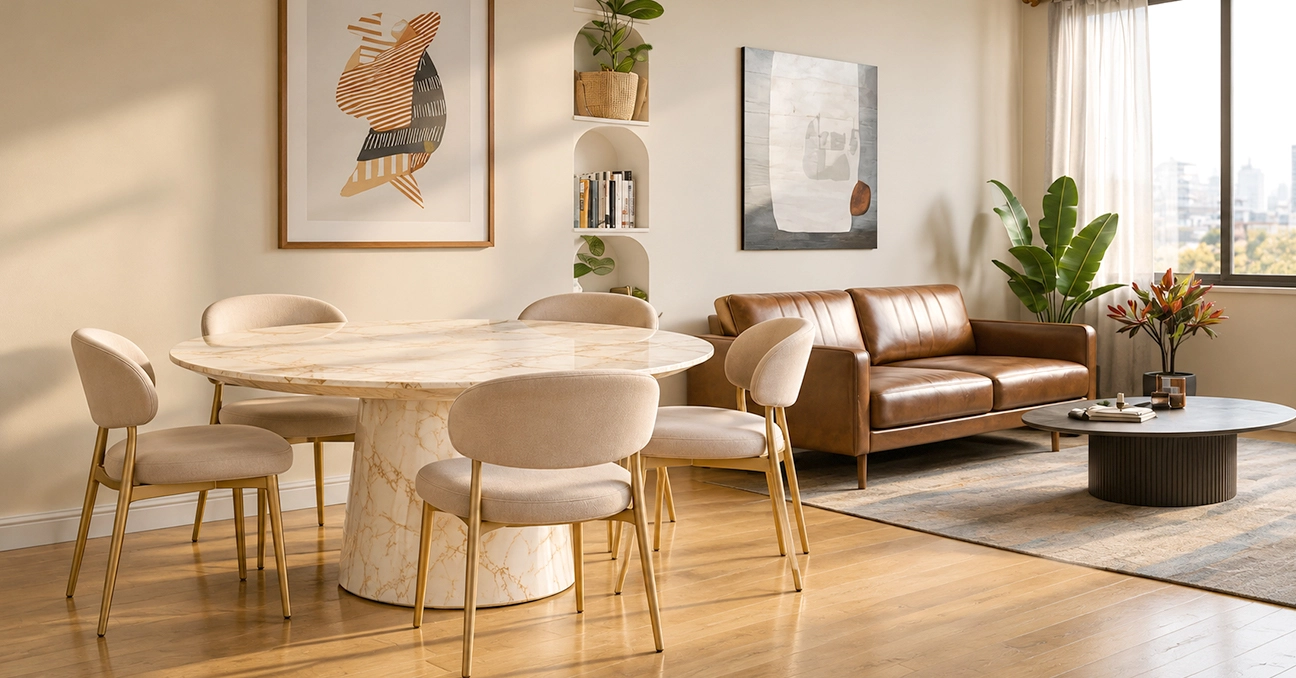
Some dining tables simply hold dinner. Others walk into the room before you do. Marble belongs firmly in the second camp. With sweeping veins, substantial proportions, and a surface that changes character under different lighting, it can turn an overlooked dining zone into a visual destination. But statement furniture comes with practical questions. Will marble overwhelm a smaller room? Can it handle everyday meals? How much maintenance does it require? And which shape actually suits your layout? Before you allow a dramatic slab take the center stage, explore what makes a marble dining table work, where complications appear, and whether your space is ready.
A statement piece does not necessarily need unusual colors or oversized dimensions. It simply needs enough visual character to influence how the surrounding room feels.
A marble dining table naturally fits that role because its surface contains patterns, tonal variation, and texture. Even when the table has a simple silhouette, the stone can provide enough visual movement to attract attention.
That changes the decorating equation.
With a quieter table, you may rely on elaborate lighting, artwork, decorative accessories, or colorful seating to create personality. Marble can carry more of that visual responsibility itself.
This doesn’t mean everything surrounding it needs to become plain. It means you should consider visual hierarchy. Decide whether the table, chairs, lighting, or artwork should receive attention first. When every object tries to become the star, the room can quickly feel crowded.
It is dangerously easy to see a beautiful table online and begin mentally redecorating your entire house around it.
Reverse the process.
Before browsing marble dining tables for sale, measure your dining space. Record its length and width, then identify doors, cabinets, walkways, kitchen islands, and other furniture that could affect movement.
The table needs enough surrounding clearance for chairs to pull back comfortably. People should also be able to move behind occupied chairs without performing an awkward sideways shuffle.
This becomes particularly important in open-plan homes where the dining areas sit between other functional zones. A table that appears properly sized on paper can still disrupt natural movement if its shape conflicts with major circulation routes.
Think of the empty space around the table as part of the furniture plan. That breathing room determines whether marble feels commanding or simply oversized.
Absolutely, provided the proportions make sense.
The misconception that marble belongs only in sprawling dining rooms often comes from seeing enormous rectangular tables used in dramatic interiors. Marble itself doesn’t require a huge room.
A compact round marble dining table can create a strong focal point without visually dividing the room with long corners. Round designs can also make movement easier in tighter layouts because people can circulate around curved edges.
Color influences visual weight too.
Paler stone can reflect available light and may appear less imposing than darker surfaces. Slimmer bases and pedestal designs can also reduce visual clutter beneath the table surface.
However, avoid choosing a small table purely because the room is compact. Seating requirements still matter. A table that functionally fits but leaves everyone fighting for elbow room has solved the wrong problem.
Balance physical dimensions, seating capacity, and surrounding clearance before considering appearance.
Marble is often reduced to a single mental picture: white stone covered with gray veins.
The reality is far broader.
Different varieties can feature cream, beige, charcoal, green, brown, reddish, or darker tones. Veining can appear delicate and scattered or bold enough to dominate the entire table surface.
This gives shoppers considerable freedom when choosing a modern marble dining table.
A lightly veined surface can sit comfortably in restrained interiors where texture matters more than contrast. Dramatic veining can become the room’s primary decorative feature. Dark marble can establish visual depth, particularly when paired with lighter chairs or walls.
The base matters just as much. Metal, timber, stone, and composite bases create different relationships with the table surface.
Instead of asking which marble looks impressive in isolation, ask which combination makes sense alongside the materials already present in your home.
One reason natural stone feels distinctive is one reason buyers need realistic expectations.
Every slab varies.
A natural marble dining table may contain differences in veining, mineral markings, shade, and pattern distribution compared with photographs displayed online. Those variations are inherent to natural materials.
For shoppers accustomed to manufactured surfaces, this requires a change in perspective. Your are not necessarily selecting an identical repeated pattern. You are choosing a material category within which individual pieces can differ.
Before purchasing, read how the seller describes natural variation. If possible, request additional photographs or ask whether the pictured table represents the exact item or merely the general stone appearance.
This is particularly important when dramatic veining influences your buying decision. If you love one specific pattern shown in a photograph, determine whether that exact pattern will appear on the table delivered to you.
Marble might look ready for a magazine photograph, but your dining table has an actual job.
Breakfast happens there. Drinks spill. Serving dishes arrive hot. Keys get dropped. Someone eventually decides the table is an excellent place for paperwork.
Natural marble is porous and can absorb substances is spills remain on the surface. Acidic ingredients may also react with the stone and create dull patches known as etching.
This makes practical habits important.
Use place-mats, coasters, serving boards, and suitable heat barriers. Wipe spills promptly. Follow the cleaning instructions supplied for the specific surface rather than reaching automatically for whichever household cleaner happens to the nearby.
When shopping for a marble dining room table, ask whether sealing is recommended and how frequently the seller suggests repeating it.
Understanding the routine before purchasing makes ownership considerably easier afterward.
Table shape affects more than appearance. It changes movement, seating, conversation, and how the dining zone relates to the rest of the room.
Rectangular table provide familiar seating arrangements and often work naturally in longer rooms. They can accommodate larger groups while visually reinforcing the room’s length.
A round marble dining table for 4 can feel more conversational because diners face each other without distant end seats. Round tables also eliminate corners, which can help in compact spaces or areas with several walking routes.
Oval designs offer interesting compromise. They provide much of the seating flexibility associated with rectangular tables while creating softer edges.
Square tables can work particularly well in square rooms, although larger versions may create substantial distances across the center.
Do not choose shape based solely on photographs. Map the footprint on your floor using removable tape before ordering. Suddenly, abstract measurements become surprisingly real.
A marble table may command attention, but chairs determine whether anyone enjoys sitting around it.
Measure the distance between the floor and underside of the table surface. Check whether armchairs can slide beneath it. Examine the position of table legs or pedestal structures because some bases reduce usable seating spaces.
If you are considering a marble dining table for 6, calculate whether six chairs can sit comfortably without colliding with the base.
Visually, chairs provide an opportunity to balance the stone.
Upholstered seating can soften marble’s harder appearance. Timber can bring warmth. Metal frames can reinforce a more architectural direction. Curved chairs can counterbalance angular table surfaces, while structured seating can echo clean geometric designs.
Matching every material is unnecessary. Contrast often makes marble more interesting.
The goal is cohesion rather than duplication.
The answer lives somewhere between your floor plan and your daily habits.
A marble dining table can transform an ordinary dining zone through natural pattern, visual depth, texture, and architectural presence. It can work in large rooms, compact apartments, contemporary interiors, softer spaces, and everything between when dimensions and styling are handled thoughtfully.
But marble asks something from its owner too. You need to understand natural variation, surface behavior, weight, delivery requirements, and everyday maintenance.
Measure first. Compare materials. Study the specifications. Think about seating. Imagine the table during breakfast, not only beneath dramatic evening lighting.
If those practical details align with your routine, marble can become more than a decorative centerpiece. It becomes the place where meals, conversations, celebrations, quiet mornings, and ordinary evenings gather around one remarkably expressive surface.